

There is a part of South America that most travelers underestimate. They fly into Lima or Bogota with a rough plan, see a few famous sites, and fly back out thinking they have covered the region. But anyone who has spent time moving slowly through Peru and Bolivia knows that the surface barely scratches what these two countries actually offer. The Short Inca Trail to Machu Picchu (2 days, 1 night) is one of the most rewarding quick treks on the continent, and fascinating Bolivia sits right next door, waiting to show you a completely different side of Andean life. Together, they make for one of the best back-to-back travel combinations anywhere in the world.
The Short Inca Trail: Small in Time, Big in Everything Else
A lot of people assume that if they cannot do the full four-day classic Inca Trail, they are missing out on the real experience. That is simply not true. The Short Inca Trail to Machu Picchu (2 days, 1 night) covers the most dramatic and historically rich section of the original route, and it does it in a way that fits into a tight schedule without cutting any corners on the quality of what you see.
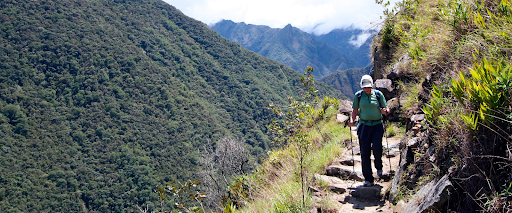
The trail starts at Chachabamba, a spot along the Urubamba River where Incan ruins already greet you before you have even taken your first proper step uphill. From there the path climbs through cloud forest, past waterfalls, and through vegetation so green and thick that it feels like the jungle is pressing in from both sides. The trail is original Incan stonework in many places, the same stones that people have walked on for hundreds of years, and that connection to history is something you feel physically underfoot.
The major stop before Aguas Calientes is Wiñayhuayna, a set of Incan ruins built into the steep mountainside that most travelers outside of Peru have never even heard of. The terraces and towers at Wiñayhuayna are extraordinary, and because the short trail sees far fewer visitors than the classic route, you often get to explore the site in genuine quiet. After Wiñayhuayna, the trail winds down to Aguas Calientes for the night, and the next morning you head up to Machu Picchu itself.
Arriving at Machu Picchu after walking part of the original Inca road gives the visit a completely different quality. You did not just buy a ticket and step off a bus. You followed a route that the Incas themselves used, passed through forest and ruins that most tourists never see, and earned the view. That feeling of arrival is something that no day trip can replicate, and it is exactly what makes the short trail worth choosing over simply taking the train.
Fascinating Bolivia: The Country That Surprises Everyone
From Cusco it is a relatively short journey to the Bolivian border, and crossing into fascinating Bolivia feels like stepping into a place that operates by its own rules and its own rhythm. Bolivia is one of the least visited countries in South America, and that is partly what makes it so good. It has not been polished for tourists. The markets are real markets, the streets have their own pace, and the landscapes are some of the most extreme and beautiful on the planet.
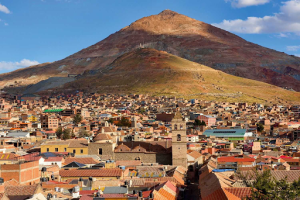
Lake Titicaca sits on the border between Peru and Bolivia and stretches deep into Bolivian territory. The lake sits at over 3,800 meters above sea level, making it the highest navigable lake in the world, and the communities that live on its shores and on its floating reed islands have maintained their way of life for centuries in a way that feels completely genuine rather than performed for visitors.
La Paz, the administrative capital of Bolivia, is one of the most unusual cities you will ever visit. It sits in a bowl surrounded by canyon walls, with the city of El Alto sprawling along the rim above it at an even higher altitude. Cable cars run between the two levels, giving you views over the whole spread of the city and the mountains beyond. The markets in La Paz, particularly the Witches Market, where vendors sell everything from dried herbs to llama fetuses used in traditional ceremonies, are unlike anything you will find anywhere else.
And then there is the Salar de Uyuni, the vast salt flat in the southwest of the country that stretches for over 10,000 square kilometers across the altiplano. In the wet season it fills with a thin layer of water that creates a perfect mirror reflection of the sky, producing images that look digitally altered but are completely real. In the dry season the hexagonal salt patterns spread to every horizon in every direction. Either way, it is one of the most visually striking places on earth, and getting there requires effort that keeps the crowds manageable.
Conclusion: The Region That Rewards Curiosity
The Short Inca Trail to Machu Picchu (2 days, 1 night) and fascinating Bolivia represent two very different kinds of travel experiences, but they share something important. Both reward the people who show up with genuine curiosity and a willingness to move a little slower and look a little more carefully than the average tourist.
The short trail gives you ancient stone paths, cloud forest, hidden ruins, and a version of Machu Picchu that feels earned. Bolivia gives you salt flats that stretch to every horizon, a capital city unlike any other, and a country that has not been smoothed out for easy consumption. Together they cover more human and natural wonder than most people see in years of travel.
If you are planning a trip to this part of the world, do not rush it. Walk the trail. Cross the border. Let Bolivia surprise you. The Andes have been here for millions of years, and they will keep being extraordinary long after you leave, but your chance to walk through them like this is happening right now.
