

The name BriansClub has become closely associated with one of the most revealing case studies in the economics of stolen payment-card data.
Sometimes shortened in searches to bclub or written as brians club, the name refers to an underground marketplace that sold stolen and leaked payment-card information. Its importance, however, goes beyond the marketplace itself. briansclub offered researchers an unusual window into how stolen financial data was collected, categorized, priced, bought, and sold within the cybercrime economy.
The subject also became particularly notable after a major 2019 compromise exposed more than 26 million stolen credit- and debit-card records. Researchers later analyzed the leaked data and found evidence of a surprisingly sophisticated marketplace, including millions of listed accounts, thousands of transactions, substantial revenue, and distinct differences in customer demand.
Understanding that ecosystem is useful because it shifts the conversation away from sensational descriptions of the dark web and toward something more concrete: how cybercrime markets actually function and what their existence teaches defenders.
What Was Briansclub?
BriansClub was an illicit online marketplace specializing in stolen payment-card information.
The marketplace was part of what cybersecurity researchers commonly describe as the carding economy. In this context, “carding” broadly refers to criminal activity involving stolen payment-card information, including the trading and monetization of compromised card data.
BriansClub was not simply a database sitting on the internet. According to NYU researchers who analyzed four years of leaked transactional information, the operation had identifiable sellers, buyers, inventory, transactions, revenue, and purchasing patterns.
That distinction is important.
Calling BriansClub merely a “carding website” captures what it sold, but not how the ecosystem worked. It functioned more like a specialized underground marketplace in which stolen information became an economic commodity.
Why the Name Became So Well Known
The name itself contributed to BriansClub’s notoriety.
The marketplace deliberately used the identity of cybersecurity journalist Brian Krebs as part of its branding. That association was not evidence that Krebs operated or endorsed the service. Instead, his identity was appropriated by the criminal operation.
This created an unusual feedback loop in cybersecurity reporting: articles about BriansClub frequently referenced Krebs, while reporting by KrebsOnSecurity naturally discussed BriansClub.
As a result, searches for briansclub, bclub, and brians club can sometimes lead readers into a mixture of historical reporting, investigative journalism, academic research, and misleading or recycled information.
How the BriansClub Ecosystem Worked
The safest way to understand the ecosystem is to focus on its economic structure rather than the mechanics of committing fraud.
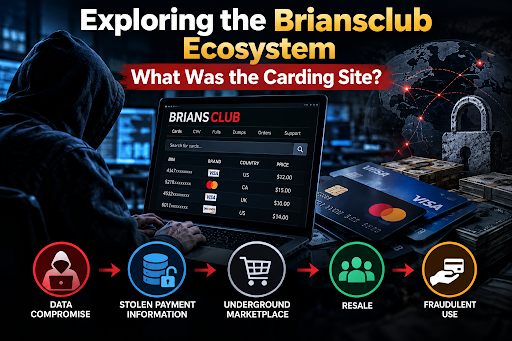
At a high level, the marketplace connected several roles:
- Data suppliers, who introduced stolen payment information into the ecosystem.
- Marketplace operators, who organized and presented the inventory.
- Customers, who sought particular categories of stolen information.
- Financial infrastructure, which supported payments and transactions.
- Victims, whose payment information had originally been compromised.
This structure matters because it demonstrates that modern cybercrime does not always depend on one person performing every stage of an attack.
Different participants can specialize in different functions.
That specialization can make criminal ecosystems more scalable and resilient than isolated attacks conducted by a single individual.
The Marketplace Had Measurable Supply and Demand
One of the most valuable aspects of the BriansClub case is that researchers had access to transactional data rather than relying only on public claims.
NYU’s analysis found that BriansClub listed more than 19 million unique card numbers for sale between 2015 and 2019. During the same period, the marketplace generated approximately $103.9 million in gross sales, with researchers estimating roughly $24 million in profit.
Those figures reveal the scale of the operation, but they also reveal something more subtle.
Not everything available in the marketplace was equally desirable.
According to the research, roughly 97% of inventory consisted of magnetic-stripe data, yet customers purchased only about 40% of that inventory. By comparison, approximately 83% of card-not-present inventory was sold.
In other words, availability did not equal demand.
That is an important principle when analyzing cybercrime markets.
Why Stolen Card Data Had Different Values
A common misconception is that all stolen payment-card information has roughly the same value.
The BriansClub research demonstrated otherwise.
Different categories of data attracted different levels of interest. The NYU researchers found that buyers appeared to distinguish between issuing banks and other characteristics of accounts, suggesting that criminals evaluated the likelihood that particular data would remain useful.
The marketplace therefore behaved like a market in which buyers assessed perceived quality.
From a defensive perspective, this matters because it demonstrates that criminals respond to security controls.
If a particular type of stolen information becomes harder to monetize, demand can shift toward another type.
That creates a continuing challenge for cybersecurity teams: improving one security layer can change attacker behavior without eliminating the underlying incentive to steal data.
The 2019 BriansClub Breach
The story took a major turn in 2019 when BriansClub itself was compromised.
A white-hat hacker obtained more than 26 million credit- and debit-card records from the marketplace. The information was provided to KrebsOnSecurity and subsequently shared with researchers, including the NYU team that studied the marketplace’s transaction history.
This event is sometimes described loosely as though BriansClub itself had been “seized.”
That wording can be misleading.
The documented event was a breach of the criminal marketplace, not simply a conventional government seizure. The distinction matters because the source and nature of the data directly affected what researchers were able to study.
Instead of investigating an underground market solely from its public-facing claims, researchers could analyze evidence drawn from its own records.
That was unusual—and extremely valuable from a research perspective.
What Researchers Discovered Inside the Ecosystem
The leaked information provided a rare empirical view of a criminal marketplace.
Researchers could examine:
- the number of sellers;
- the number of customers;
- the quantity of listed inventory;
- completed purchases;
- transaction activity;
- gross revenue;
- differences between categories of stolen data.
The underlying research dataset covered January 2015 through January 2019 and identified 121 sellers and approximately 68,000 buyers after deduplication, according to the study’s summary table. It recorded approximately 19.45 million accounts in inventory and about 7.83 million sold.
These numbers are particularly useful because they challenge the assumption that underground markets operate without recognizable economic structures.
They do.
They have inventory. They have customers. They have prices. They have supply constraints. They have demand fluctuations.
The criminal nature of the activity does not eliminate economic behavior.
BriansClub and the Evolution of Payment Security
The BriansClub research also exposed an important weakness in assumptions about EMV chip technology.
EMV chips were introduced to make counterfeit card transactions more difficult. But the existence of chip technology did not eliminate stolen payment data.
NYU researchers found that during the final two years of the leaked dataset, 85% of stolen magnetic-stripe data originated from cards that had EMV chips. The problem was that those cards could still be exposed through transactions involving the magnetic stripe.
The lesson is broader than BriansClub.
Security controls are rarely absolute.
A new technology may close one avenue while another remains available.
For defenders, the appropriate response is not to declare a technology ineffective. Instead, security teams need to understand which attack paths the technology addresses—and which ones remain.
The Carding Site Was Also a Lesson in Cybercrime Specialization
BriansClub provides a useful example of how cybercrime became increasingly specialized.
A criminal ecosystem can involve separate participants handling different stages of the process.
One group may obtain compromised information.
Another may aggregate it.
A marketplace may organize and advertise it.
Customers may then attempt to monetize it elsewhere.
This separation creates what researchers sometimes describe as a crime-as-a-service environment.
The practical significance for cybersecurity is substantial.
Defenders cannot necessarily stop a complete criminal operation by looking for one attacker or one infrastructure component. A successful investigation may require understanding the relationships among multiple actors and services.
What Happened to the Marketplace After Its Exposure?
The 2019 breach dramatically disrupted BriansClub’s secrecy and exposed the scale of its operations.
But it is important to distinguish between exposure, disruption, shutdown, and law-enforcement action.
These terms are not interchangeable.
A criminal marketplace can be breached without being formally seized. Its database can be exposed without every participant being identified. Its infrastructure can disappear without the entire criminal ecosystem disappearing.
That distinction is one reason claims about the later status of BriansClub should be treated carefully.
A historical reference to BriansClub does not necessarily describe an active service, and a current-looking page using the name does not establish that it is the original marketplace.
Why Searches for “BriansClub” Can Be Misleading
The continued visibility of bclub, briansclub, and brians club creates a separate cybersecurity problem: search ambiguity.
Someone researching the historical marketplace might encounter:
- old news reports;
- academic research;
- archived security investigations;
- copied articles;
- misleading advertisements;
- impersonation attempts;
- phishing pages;
- unrelated sites using similar terminology.
That means a search result should never be treated as proof of authenticity.
The name alone cannot establish who operates a website or whether a service is connected to the historical BriansClub.
Historical Information Can Look Current
This is particularly important with cybersecurity topics.
A page published several years ago can continue ranking for searches because it contains authoritative historical information.
That does not mean the events described on the page are still occurring.
Researchers should therefore look at publication dates and ask what period the evidence actually covers.
The NYU study, for example, analyzed data from 2015 through 2019. Its findings are valuable historical evidence, but they should not automatically be presented as measurements of the cybercrime economy in 2026.
What the BriansClub Case Teaches Cybersecurity Professionals
The BriansClub ecosystem offers several enduring lessons.
1. Cybercrime Has Economics
Criminal marketplaces respond to supply, demand, perceived quality, pricing, and security controls.
Understanding those incentives can help defenders anticipate changes in attacker behavior.
2. Large Breaches Need Context
“Millions of records” sounds definitive, but exposure, availability, purchase, and successful misuse are separate measurements.
BriansClub demonstrated this particularly well because a large portion of its listed inventory was never purchased.
3. Security Technologies Change Behavior
EMV reduced certain forms of counterfeit-card fraud but did not eliminate payment-card theft.
Attackers adapted to remaining opportunities.
4. Evidence Is More Valuable Than Underground Claims
The strongest BriansClub research came from analysis of actual marketplace data.
That is a useful reminder for threat intelligence teams: distinguish between what criminals claim, what journalists report, and what independently verified evidence demonstrates.
5. Search Results Require Context
A keyword such as bclub can lead to very different types of information.
Researchers should verify the source, publication date, evidence, and historical context before treating a page as authoritative.
What Consumers Can Learn From the BriansClub Story
The existence of a marketplace selling stolen payment-card information reinforces several basic security practices.
Consumers should:
- monitor financial accounts regularly;
- enable transaction notifications where available;
- report suspicious transactions promptly;
- use strong, unique passwords for financial accounts;
- enable multi-factor authentication where supported;
- avoid entering financial information into unfamiliar websites;
- keep operating systems, browsers, and security software updated.
No single precaution guarantees that payment information will never be compromised.
The broader lesson is that payment security depends on multiple layers, including banks, merchants, payment networks, technology providers, and consumers.
The Bigger Significance of BriansClub
It is tempting to view BriansClub simply as another infamous dark-web marketplace.
The research tells a more useful story.
BriansClub became a natural laboratory for understanding the economics of stolen payment information. Researchers were able to study an underground marketplace at a level of detail that is rarely possible.
They found a market with millions of listed accounts, substantial revenue, thousands of buyers, hundreds of sellers, uneven demand, and significant amounts of unsold inventory.
That evidence helps explain why cybercrime cannot be understood solely as a collection of isolated hacking incidents.
There is an economy behind many forms of digital crime.
Understanding that economy can help security professionals identify incentives, recognize changing attack patterns, and design defenses that address not only technical vulnerabilities but also the economic conditions that make particular attacks attractive.
Final Takeaway
The BriansClub ecosystem was significant because it demonstrated how organized the market for stolen payment-card information could become.
Under the shorthand bclub or the search phrase brians club, the subject can appear deceptively simple: a carding site that sold stolen data.
The documented evidence reveals something much more complex.
BriansClub operated as an underground marketplace with identifiable suppliers, customers, inventory, transactions, and revenue. Researchers found more than 19 million unique card numbers listed for sale and approximately $103.9 million in gross sales across the period analyzed.
Its 2019 compromise then exposed more than 26 million stolen payment-card records, providing researchers with an unusually valuable dataset for studying the criminal marketplace itself.
The lasting lesson is not about how to participate in such markets. It is about understanding why they exist, how technology changes their economics, and what defenders can learn from the evidence they leave behind.
BriansClub is therefore best understood not simply as a notorious carding site, but as a case study in cybercrime economics, payment security, data theft, market specialization, and threat intelligence.
And that is ultimately why the BriansClub story continues to matter.
