

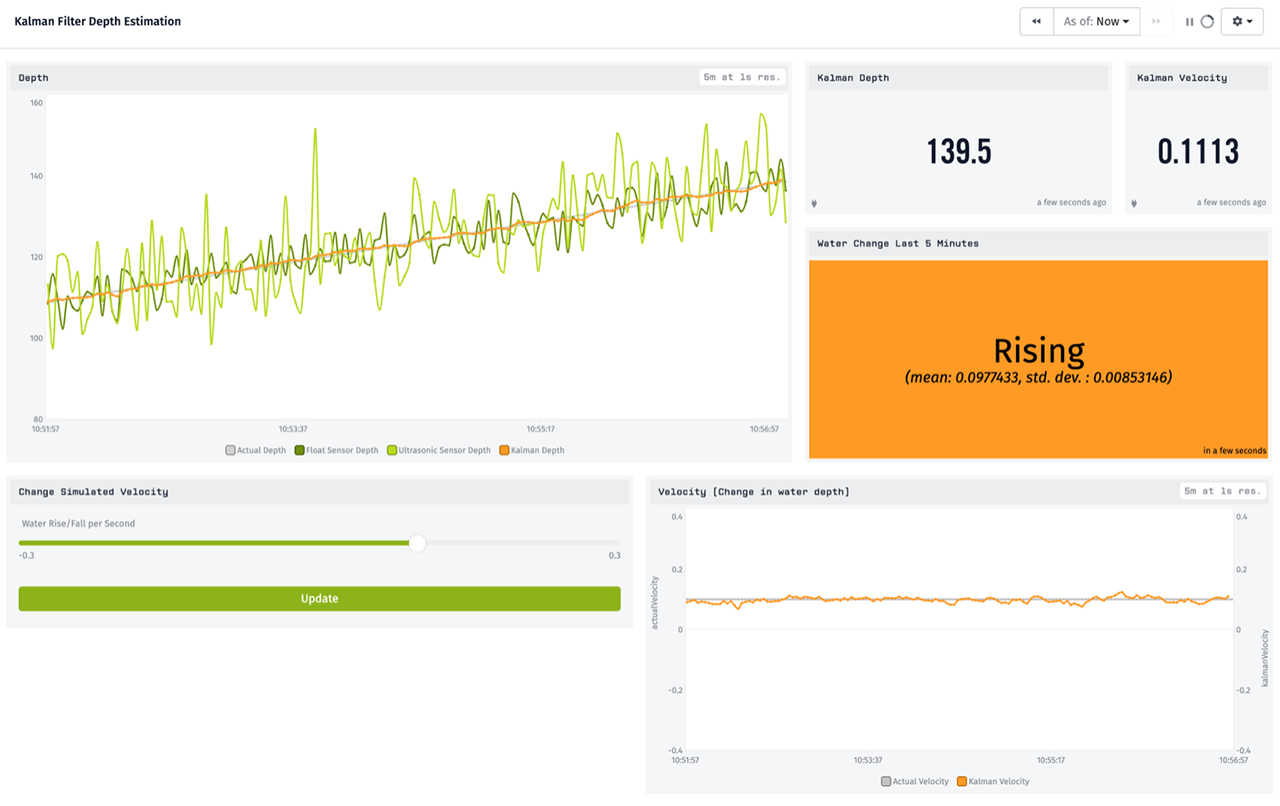
Time series data is rarely clean. Sensors drift, readings arrive with delays, and real-world processes often hide their true internal state. In many practical situations, you are not trying to predict the next value directly; you are trying to estimate an underlying “state” that cannot be measured perfectly. Kalman filtering is a classic approach for this problem. It is a recursive algorithm that estimates the true state of a system from noisy and indirect measurements, updating its belief each time a new observation arrives. For learners exploring applied time series methods in a data science course in Chennai, Kalman filtering is a valuable bridge between theory and real operational forecasting.
What “State Estimation” Means in Time Series
In time series analysis, the state is the hidden condition of a system that drives what you observe. Consider examples:
- A delivery vehicle has a true position and velocity, but GPS measurements are noisy.
- A manufacturing line has a true machine health level, but you only see vibrations and temperature readings.
- A financial instrument has a latent trend and volatility, but you observe prices influenced by noise and sudden shocks.
State estimation means building a model that separates the signal (true state) from measurement noise, then continuously refining the estimate as new data points arrive. Kalman filtering is designed exactly for this. It works best when the process and measurement relationships can be written in linear form with Gaussian noise, although there are extensions for non-linear cases too.
This idea is central in many advanced time series topics covered in a data science course in Chennai, because it supports real-time analytics where decisions must be made instantly rather than after batch processing.
The Core Idea Behind the Kalman Filter
Kalman filtering follows a simple loop: predict, then update. The filter maintains two key things at every time step:
- State estimate: the best current guess of the true state
- Uncertainty estimate: how confident the filter is about that guess
Step 1: Predict (Time Update)
Using a known system model, the filter projects the state forward. For example, if the state includes position and velocity, the model predicts where the object should be next based on motion equations. Along with the predicted state, it also predicts increased uncertainty because the future is never fully certain.
Step 2: Update (Measurement Update)
When a new measurement arrives, the filter combines it with the prediction. If the measurement is very noisy, the filter trusts the prediction more. If the measurement is reliable, it shifts closer to the measurement. This balance is controlled by a quantity known as the Kalman gain, which is computed from the predicted uncertainty and measurement noise.
Because this loop is recursive, it is computationally efficient. You do not need to store the entire time series history. You only need the previous state estimate and its uncertainty. That is a key reason Kalman filtering is used in embedded systems, streaming pipelines, and real-time monitoring.
Why Kalman Filtering Works Well for Noisy Measurements
Many forecasting methods treat time series values as “the truth.” Kalman filtering treats them as evidence. This small shift in thinking makes it powerful in messy environments.
It explicitly models noise
Instead of hoping noise averages out, the filter uses a measurement noise parameter to represent how unreliable observations are. If your sensor quality changes, the model can be adjusted accordingly.
It adapts to new information
A Kalman filter updates as soon as new data arrives. This is useful in situations such as tracking, anomaly detection, and operational forecasting where waiting for daily batches is too slow.
It produces uncertainty, not only point estimates
In production systems, knowing confidence matters. A predicted state with low uncertainty can be acted on automatically, while high uncertainty might trigger human review or request more data. This practical mindset is often emphasised in a data science course in Chennai, because uncertainty-aware decisions are safer and more realistic.
Practical Use Cases in Business and Engineering
Kalman filtering shows up in many domains that rely on time series.
Sensor fusion and tracking
In GPS + accelerometer tracking, each sensor has different weaknesses. Kalman filters combine multiple signals to estimate a smoother and more accurate position and velocity.
Demand and inventory smoothing
Retail demand signals are noisy due to promotions, seasonality, and stock-outs. Kalman filtering can estimate a latent demand trend that is less sensitive to spikes.
Predictive maintenance
Machine vibration and temperature readings often fluctuate. A state-space model can represent latent health. Kalman filtering then helps estimate degradation over time and detect abnormal shifts early.
Finance and risk signals
Analysts use state-space models to estimate hidden trends or time-varying parameters such as changing volatility. While markets can be non-linear, the Kalman framework is still a useful starting point.
Common Pitfalls and How to Handle Them
Kalman filtering is not “set and forget.” The results depend on modelling choices.
- Incorrect noise settings: If measurement noise is underestimated, the filter overreacts to noisy data. If it is overestimated, the filter becomes slow to respond.
- Wrong state definition: If the state does not reflect how the system actually behaves, predictions drift.
- Linear assumptions: Standard Kalman filters assume linear relationships. If your system is non-linear, you may need an Extended Kalman Filter (EKF) or Unscented Kalman Filter (UKF).
A disciplined workflow is to start simple, validate assumptions, and tune noise parameters using historical performance. This kind of careful iteration mirrors how applied time series is taught in a data science course in Chennai, especially when learners move from notebooks to real deployment.
Conclusion
Kalman filtering is a practical, efficient method for time series state estimation when measurements are noisy and indirect. By repeatedly predicting the next state and updating that estimate using new observations, it separates signal from noise in a mathematically grounded way. Its recursive design makes it ideal for real-time systems, and its ability to track uncertainty supports better decisions. For anyone building time-aware models in operations, engineering, or analytics, mastering Kalman filtering is a strong step forward—and it fits naturally into the applied toolset developed in a data science course in Chennai.
